Home / Case Studies / Port & Phish Scanner
Port & Phish Scanner
Project type: Independent build
Phishing attacks and exposed services are real threats that small businesses cannot easily investigate.
Detecting suspicious URLs, exposed services, and basic security weaknesses often requires multiple tools or manual inspection. Small businesses and individuals may not have access to expensive security platforms or the technical expertise needed to use them effectively.
Built the frontend of a security assessment tool that brings multiple checks into one readable interface.
A user submits a domain, URL, or IP address and the interface is designed to present phishing detection, DNS analysis, and port scanning in one report instead of raw scan data. The backend API integrations and analysis logic are still in progress.
How the system works
The platform is designed around a single scan flow that combines several security checks and presents the results in one report.
Security assessment interface
The interface is designed to keep a potentially complex security assessment understandable without burying users under technical noise.
Frontend complete · Backend in progress
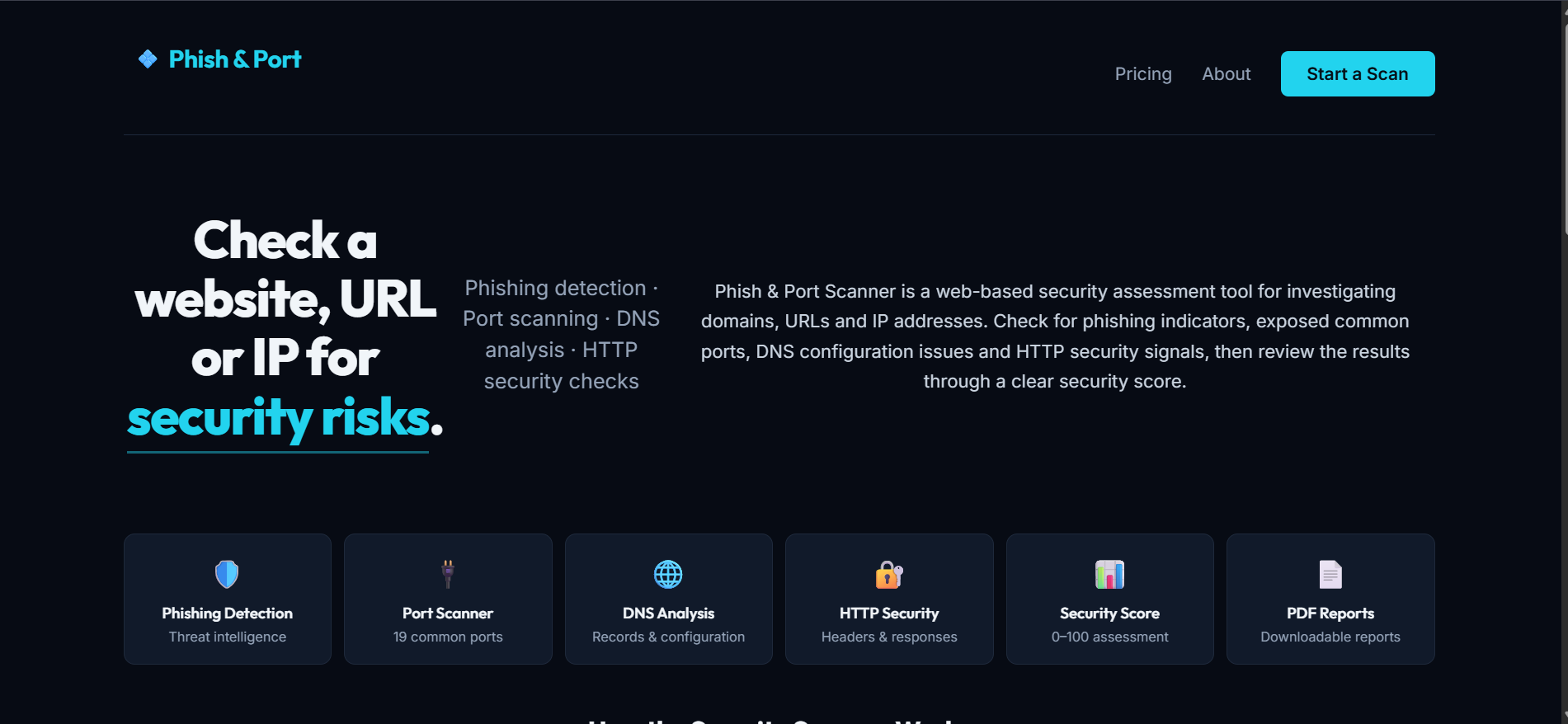
The Port & Phish Scanner interface.
What has been built
The project currently has a complete frontend and a backend architecture being developed to support the actual security checks.
- Frontend — Complete security assessment interface deployed on Vercel.
- Scan interface — Supports domain, URL, and IP-based security assessment flows.
- Backend — In progress, including API integrations and security analysis logic.
- Next — Complete API integration, DNS analysis, threat intelligence checks, HTTP security checks, and port scanning.
Key decisions and compromises
Security tooling involves balancing depth, speed, cost, and usability. The project is designed around practical checks rather than pretending one scan can magically solve cybersecurity.
- Free vs paid data sources — free threat intelligence sources reduce operating costs but may provide less coverage or slower responses.
- Speed vs depth — scanning a focused set of common ports keeps results practical without turning every scan into an unnecessarily long process.
- Simple interface — the interface deliberately keeps the first interaction straightforward while still exposing detailed results after a scan.
A complete, deployed frontend is live on Vercel, but this is not a finished end-to-end result yet.
The backend still needs to ship before the product can run real DNS analysis, threat intelligence checks, HTTP security checks, and port scanning and produce actual scan output.
- Frontend-first development helps validate the product experience before the backend is complete.
- Security tools need careful architecture because inaccurate results can create a false sense of safety.
- Building the backend properly matters more than rushing to make every feature appear functional.
Need a security tool or custom software for your business?
Start a Project →